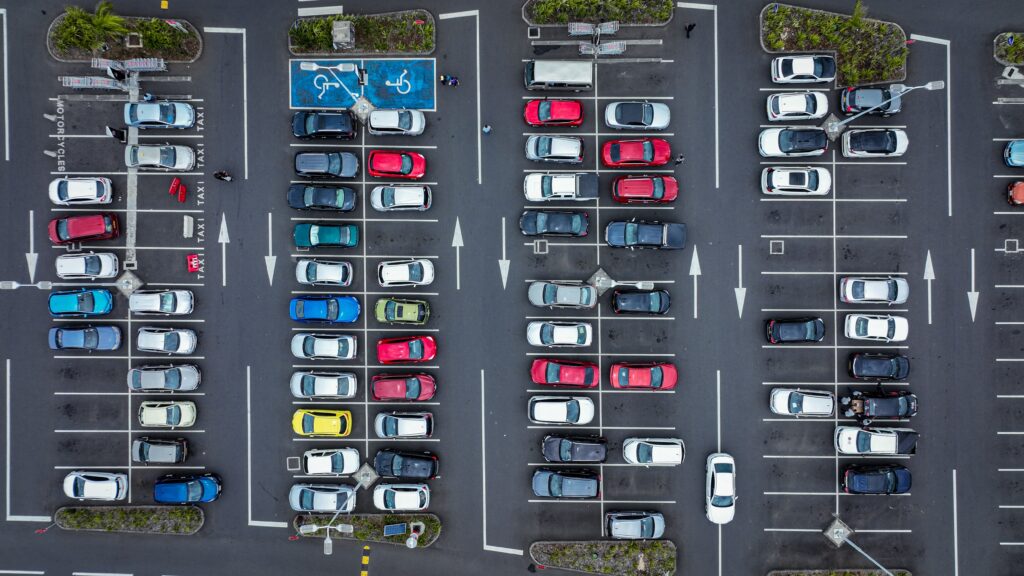
The Parking Lot Is Your Most Exposed Asset
Parking lot security cameras are essential because your lot is open to everyone: customers, employees, and criminals alike. Vehicle break-ins, catalytic-converter theft, organized retail crime, vandalism, and loitering often concentrate in these exposed areas, especially after hours.
That exposure creates a compounding problem: the same space that drives foot traffic to your business also drives premises-liability risk, insurance claims, and reputational damage.
Most businesses respond by installing parking lot security cameras.
That’s a start.
The question isn’t whether you have cameras but whether those cameras can actually stop an incident or only document one after it’s too late.
This guide covers camera types, placement, cost, and how to build a parking lot security system that deters crime in real time, not just records it.
What Parking Lot Security Cameras Do (and Don’t Do) Today
Standard parking lot CCTV delivers real value.
A visible camera is a passive deterrent. Recorded footage supports insurance claims, police investigations, and legal proceedings. A well-documented system can reduce your liability exposure and, in some jurisdictions, lower your commercial insurance premiums.
But parking lot video surveillance has structural limits that most vendors don’t advertise:
- Review happens after the fact. Most systems record continuously and alert on motion. By the time a human reviews the footage, the incident is over, and the suspect is gone.
- Motion ≠ behavior. A motion trigger fires on a blowing leaf, a passing car, or a delivery driver… And on a catalytic-converter theft. The system can’t tell the difference, so operators learn to ignore false alerts.
- High false-alarm rates erode trust. When 95% of alerts are noise, the 5% that matter get missed. Law enforcement in many cities has deprioritized unverified alarm calls for exactly this reason.
- DVR/NVR vulnerability. On-site recorders can be stolen, damaged, or tampered with, taking your evidence with them.
- No real-time response capability. A camera that only records cannot warn an intruder, contact a monitoring center, or trigger a deterrent. It watches. It does not act.
The gap between detection and response is where parking lot crime lives. Closing that gap requires a different architecture.
Types of Parking Lot Security Cameras
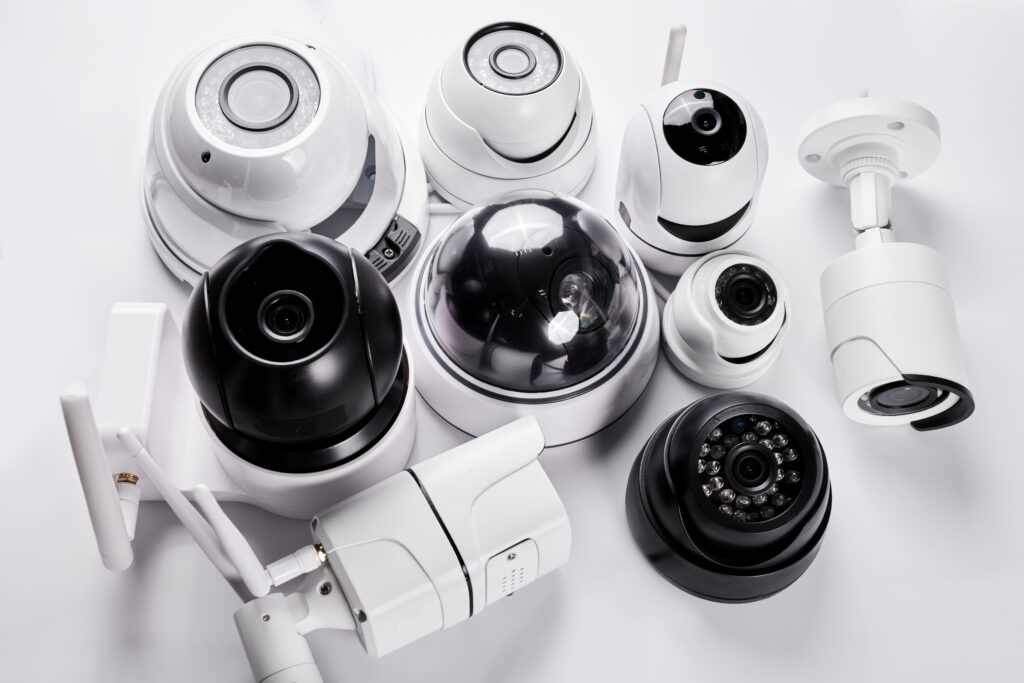
Choosing the right camera type for each zone in your lot matters more than resolution alone. Here’s how each type maps to real parking lot scenarios, and the trade-off you need to know before you buy.
Bullet Cameras
Best for: Defined coverage of areas comes in verity of focal lengths, many options on the market, also visible to people which creates some level of deterrence.
Trade-off: Not vandal resistant could be misaligned over time due to wind or environmental factors.
Dome Cameras
Best for: Covered garages, canopies, indoor and areas where vandal resistance matters. Aesthetically pleasing.
Trade-off: Discreet profile and IK10 vandal rating make them harder to defeat, but the dome housing can reduce image clarity at extreme angles. Can also need more cleaning and regular maintenance when outside do to dust and other environmental challenges
Turret Cameras
Best for: Great middle choice between bullets and domes while keeping characteristics of both
Trade-off: Could still be moved by vandals as it is not sitting in a protective dome.
PTZ (Pan-Tilt-Zoom) Cameras
Best for: Large open lots where a single camera needs to cover multiple zones or track a moving subject or for dealers who need to reposition cameras without truck roles. Even if the end user uses it as fixed lens.
Trade-off: Powerful and flexible, but a PTZ pointed in one direction covers nothing else. Pair with fixed cameras for full coverage. Can become challenging when customer moves PTZ out of defined detection areas
180 Degree Cameras
Best for: Intersections, large open areas, driveways, sides of buildings locations where you need 180°.
Trade-off: Higher upfront cost, but can replace multiple fixed cameras in the right geometry. What you gain in width you lose in distance.
Multi Sensor Cameras
Best for: Limited Wire Runs and covering multiple areas with one pull
Trade-off: Higher upfront cost, but can replace multiple fixed cameras in the right geometry. Will occupy multiple channels on most VMS solutions.
360 Degree Cameras / Fisheye
Best for: Indoor commercial areas with open space and outdoor specific birds eye views like under a security trailers or canopies.
Trade-off: Higher upfront cost, but can replace multiple fixed cameras in the right area. To take advantage of the full area the image will not be dewarped but it can cover a large area with one camera.
Wireless Cameras
Best for: Locations where running conduit is cost-prohibitive or disruptive — older structures, leased properties, temporary deployments.
Trade-off: Dependent on Wi-Fi signal strength and possibly battery. Wireless parking lot security cameras require more maintenance planning than wired equivalents.
Wired Cameras on Point to Point
Best for: Poles with power but no network and extending the perimeter outside on large lots or adjacent lots
Trade-off: Dependent on signal strength of Point to Points and reliability of your point to point network overall. Make sure to plan this out well before deployment.
Wired Cameras on All in One Cellular connected boxes
Best for: Poles with power but no network and extending the perimeter outside on large lots or adjacent lots or the sole solution. Great for construction sites, car lots, etc
Trade-off: Dependent on signal strength of cellular provider and if you use multiple poles you may have to get a cellular plan for each pole unless linking with Point to Points.
Solar-Powered / Mobile Security Towers
Best for: Lots without power infrastructure, construction staging areas, overflow lots, or temporary high-risk deployments.
Trade-off: A parking lot security tower offers rapid deployment and cellular connectivity, but it can represent a significant rental or capital expense and may need to be repositioned as site requirements change. Frequent transportation and exposure to changing environments can also increase wear, maintenance needs, and replacement costs.
Shared requirement across all types: Any camera deployed outdoors in a parking lot should carry an IP66 or IP67 weather rating and, where tampering is a risk, an IK10 vandal rating.
These aren’t optional.
They’re the baseline for a camera that survives a full season in an exposed environment.
CHeKT works with existing cameras of any type. No rip-and-replace required. If your cameras can stream video, CHeKT can make them proactive.
Where to Place Cameras and Plan Coverage
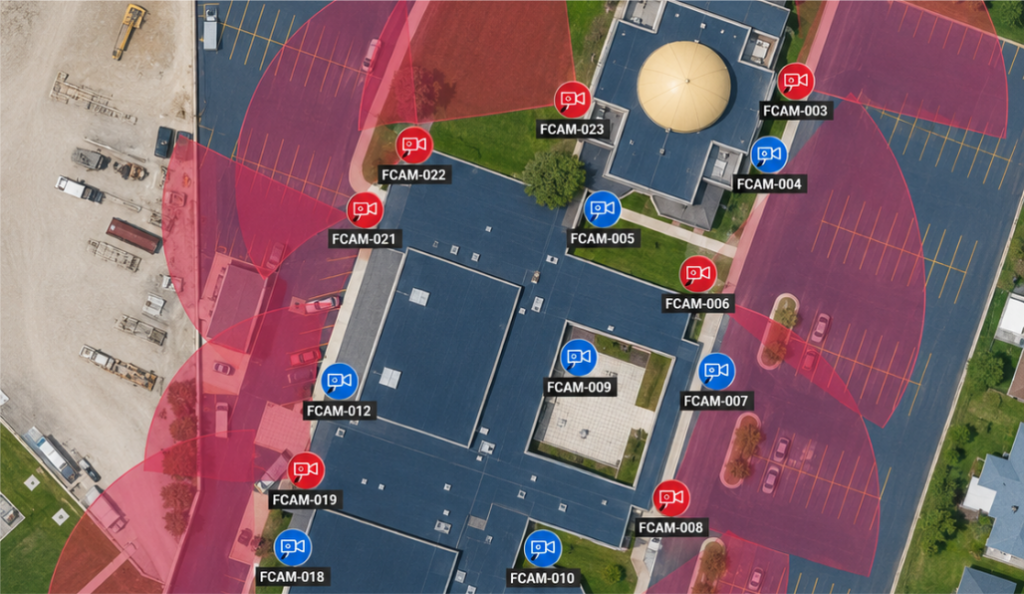
Camera placement determines whether your system captures usable evidence or just records empty asphalt.
Placement is a planning, strategic decision, not an afterthought.
Parking Lot Camera Coverage Checklist
☐ Entrances and exits — Mount LPR or high-resolution cameras to capture license plates on every vehicle entering and leaving. Angle matters: plates must be readable, not just visible.
☐ High-value / high-risk zones — Catalytic-converter theft concentrates under SUVs and trucks. Identify where those vehicles park and ensure coverage.
☐ Pedestrian walkways and building entries — Capture faces and behavior at the transition point between the lot and your building.
☐ Perimeter fencing and access points — Perimeter breaches are often the first step in ORC staging. Cover fence lines, gaps, and secondary access points.
☐ Blind spots — Walk the lot at night. Identify where lighting fails, where dumpsters or landscaping create concealment, and where camera angles leave gaps.
☐ Lighting and night vision — Cameras without adequate lighting or IR/low-light capability produce unusable footage after dark. Audit your lighting plan alongside your camera plan.
☐ Weather and vandal ratings — Confirm IP66/67 and IK10 ratings for every outdoor unit.
Takeaway: A camera in the wrong location — or with the wrong field of view — is a false sense of security. Map your coverage before you mount anything.
Passive Surveillance vs. Proactive Visual Security

Here’s the problem no one in the parking lot CCTV industry wants to name directly: recording an incident is not the same as preventing one.
Traditional parking lot video surveillance operates on a passive model. A camera detects motion, logs an event, and stores footage. If someone reviews it — hours or days later — they may find evidence of a crime.
That evidence is valuable. But the crime already happened.
The detection-to-action gap is the window between when a camera first captures suspicious behavior and when a human being takes action. In a passive system, that gap is measured in hours. In a proactive system, it’s measured in seconds.
Proactive visual security closes the gap with three components working in sequence:
- AI behavioral detection — Instead of triggering on motion, the system analyzes behavior. A person walking to their car is different from a person crouching under vehicles in the same row. AI distinguishes between the two and escalates only genuine threats.
- Live human verification — A trained monitoring operator reviews the flagged event in real time, not the next morning. They confirm whether the behavior is a threat before any action is taken. This is what eliminates false alarms.
- Real-time two-way audio deterrence — The verified operator speaks directly to the subject through an IP speaker mounted in the lot: “This is a monitored security system. You are being recorded. Please leave the area immediately.” Most subjects leave. No police response required.
| Passive CCTV | CHeKT Proactive Visual Security | |
|---|---|---|
| Detection | Motion trigger | AI behavioral analysis |
| Review | After the fact (hours/days) | Real-time live operator verification |
| Response | None; record only | Voice-down deterrence, lights, sirens, or verified dispatch |
| Evidence | DVR/NVR (on-site, vulnerable) | Video Vault (cloud-stored, audit-ready, tamper-resistant) |
| False alarm rate | High; motion = alert | Low, human-verified before escalation |
| Existing camera integration | Varies by vendor | Yes; no rip-and-replace |
| Access control correlation | Rarely | Native integration |
The IEEE has noted that parking lot security “can’t be solved with a simple CCTV camera”, and the data supports it.
Proactive monitoring with verified response is the architecture that actually changes outcomes.
How CHeKT Makes Parking Lot Cameras Proactive

CHeKT’s proactive visual security platform connects to your existing parking lot camera system and adds the detection, verification, deterrence, and evidence layers that passive CCTV cannot deliver.
Here’s how the flow works:
1. AI Detection
CHeKT’s AI engine analyzes the video stream from your existing cameras, filtering out environmental noise and flagging behavioral anomalies: loitering, perimeter breach, vehicle tampering, after-hours presence in restricted zones.
2. Live Operator Verification via the Monitoring Portal
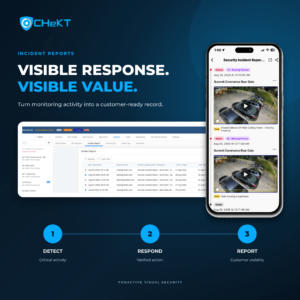
Flagged events are routed to a trained monitoring operator through CHeKT’s Monitoring Portal. The operator reviews the live or near-live clip — typically within seconds — and makes a judgment: genuine threat or false alarm. This step is what separates proactive visual security from automated alert spam.
3. Real-Time Deterrence via IP Speakers
If the operator confirms a threat, they activate CHeKT’s IP Speakers, mounted in your lot, to deliver a live, direct voice-down to the subject. Lights and sirens can be triggered simultaneously. The goal is deterrence before damage, not documentation after it.
4. Event Routing via the Video Control Panel
Every verified event is logged and routed through CHeKT’s Video Control Panel. If deterrence doesn’t resolve the situation, the operator escalates to verified dispatch. Law enforcement receives a confirmed, in-progress incident rather than an unverified alarm call.
5. Evidence Retained in Video Vault
Every verified event is stored in CHeKT’s Video Vault, cloud-based, timestamped, and audit-ready. Unlike a DVR bolted to a wall in your back office, Video Vault survives equipment theft, power loss, and tampering. Footage is retrievable for insurance claims, police investigations, and legal proceedings.
No rip-and-replace. CHeKT integrates with the cameras you already have. The upgrade is in the intelligence and response layer, not the hardware.
Integrating Video Verification with Access Control and Gates
A gate log that shows an after-hours entry is a data point. A gate log paired with verified video of who entered, and what they did next, is evidence.
CHeKT integrates with access control systems and gate controllers so that every credentialed entry or exit event has visual context. When a gate opens at 2:00 a.m. on a Sunday, the event doesn’t just log silently but triggers a verification workflow. A monitoring operator reviews the associated video, confirms whether the entry is authorized, and escalates if it isn’t.
This correlation closes a gap that access control alone cannot address: tailgating, credential sharing, and forced entry all produce access events that look legitimate in the log but are visible anomalies on camera.
Together, video and access control catch what either system misses alone.
For retail and multi-tenant properties, this integration also supports audit trails — a timestamped record of who accessed which area, when, with visual confirmation.
That record has value in HR investigations, vendor disputes, and premises-liability claims.
Proactive Video Outcomes from High-Risk Retail and Asset Protection

The question buyers ask (and vendors rarely answer directly) is: does this actually work?
CHeKT’s proactive visual security model has produced measurable outcomes across high-risk exterior environments:
- Construction and equipment yards: After-hours intrusions deterred through live voice-down before equipment was touched. Verified dispatch called only when deterrence failed, reducing false alarm calls and improving law enforcement response times.
- Warehouse and distribution perimeters: Behavioral AI identified loitering patterns consistent with ORC staging. Operators intervened before any breach occurred.
- Multi-site retail deployments: Centralized monitoring across multiple locations reduced the per-site cost of security while maintaining consistent response protocols. False alarm rates dropped significantly after switching from motion-based to AI-verified alerting.
- Multi-site retail deployments: Centralized monitoring gives retailers consistent response protocols across every location while reducing unnecessary dispatches. Industry results demonstrate the value of verification: one monitoring provider reports clearing up to 93% of alarm signals before escalation, with only 7%–9% resulting in dispatch. Academic research has also found that historically more than 90% of alarm dispatches were false, underscoring the need for AI filtering and human verification.
- Verified dispatch advantage: When law enforcement receives a verified alarm — a human operator confirming an in-progress incident — response priority increases. Unverified alarm calls are routinely deprioritized in high-volume markets.
What Parking Lot Surveillance Cameras Cost and How to Budget for Them
Parking lot security camera system costs vary widely, and any vendor who quotes a flat price without understanding your lot is guessing.
The real cost drivers are:
- Lot size and camera count — A 20-space strip-mall lot and a 500-space retail center have fundamentally different coverage requirements.
- Connectivity — Wired cameras require conduit runs. Wireless cameras require reliable Wi-Fi. Solar/LTE cameras for lots without power infrastructure carry a connectivity premium.
- Hardware rating — IP66/67 and IK10-rated cameras cost more than consumer-grade equivalents. They also last longer and withstand the conditions that destroy cheaper units.
- Monitoring model — Self-monitored systems cost less upfront and more in missed incidents. Professionally monitored systems with live verification carry a recurring cost, offset by reduced losses, lower insurance premiums, and fewer false-alarm fees.
- Integration scope — Adding access control correlation, LPR, or multi-site management increases system complexity and cost.
Frame the investment against what it offsets: A single catalytic-converter theft costs $1,000–$3,000 in parts and labor. A vehicle break-in claim can cost $500–$2,000 plus insurance premium increases. A premises-liability suit from an assault in an inadequately secured lot can cost orders of magnitude more. The question isn’t what a proactive parking lot security system costs — it’s what the absence of one costs.
CHeKT’s upgrade path uses your existing cameras to control hardware cost. The investment is in the intelligence and monitoring layer, not a full hardware replacement.
Parking Lot Security System Buying Checklist

Use these questions when evaluating any parking lot security camera system or monitoring provider. The best parking lot security cameras are only as good as the system they’re part of.
☐ Does the system use AI behavioral detection or just motion triggers that generate constant false alarms?
☐ Is there live human verification before any alert is escalated or dispatch is called?
☐ Can the system deliver real-time two-way audio deterrence through IP speakers in the lot?
☐ Is video retained in cloud-based storage that survives on-site equipment theft or tampering?
☐ Does the system integrate with existing cameras or does it require a full hardware replacement?
☐ Can it integrate with access control systems and gate controllers to correlate entry events with video?
☐ Is the system scalable across multiple sites from a single monitoring portal?
☐ What is the monitoring model: self-monitored, automated alerts, or live professional monitoring with verified response?
☐ How does the system handle lots without reliable power or internet? Is solar/LTE connectivity supported?
☐ How is audit-ready footage retrieved for insurance claims, police reports, or legal proceedings, and how long is it retained?
Build a Proactive Parking Lot Security Plan With CHeKT
Turn Existing Cameras Into Real-Time Crime Prevention
Recording what happens in your parking lot is no longer enough. The businesses that reduce break-ins, deter ORC, and protect their premises liability are the ones that close the gap between detection and response with AI, live verification, and real-time deterrence.
CHeKT connects to your existing parking lot cameras and adds the proactive layer your current system is missing: behavioral AI, live operator verification, IP-speaker voice-down deterrence, and audit-ready Video Vault evidence.
Find a CHeKT-Certified Provider →
Request a Demo →