Why lone worker safety matters in restaurants and QSRs
24×7 restaurant monitoring is becoming an essential component of employee safety programs, particularly for lone workers at restaurants, quick-service restaurants (QSRs), convenience stores, and fuel stations. While many organizations invest heavily in surveillance cameras, few have a proactive protection strategy for employees during their most vulnerable moments.
When a manager walks to their vehicle after closing, when an employee takes out the trash after midnight, or when a single worker opens a location before sunrise, the risks extend far beyond theft. These moments expose employees to workplace violence, harassment, robbery, and other threats that can impact both people and business operations.
This article explores the unique risks facing lone workers, the technologies helping organizations reduce those risks, and best practices for creating safer environments across multiple locations.
Why Lone Worker Safety Is Becoming a Business Priority
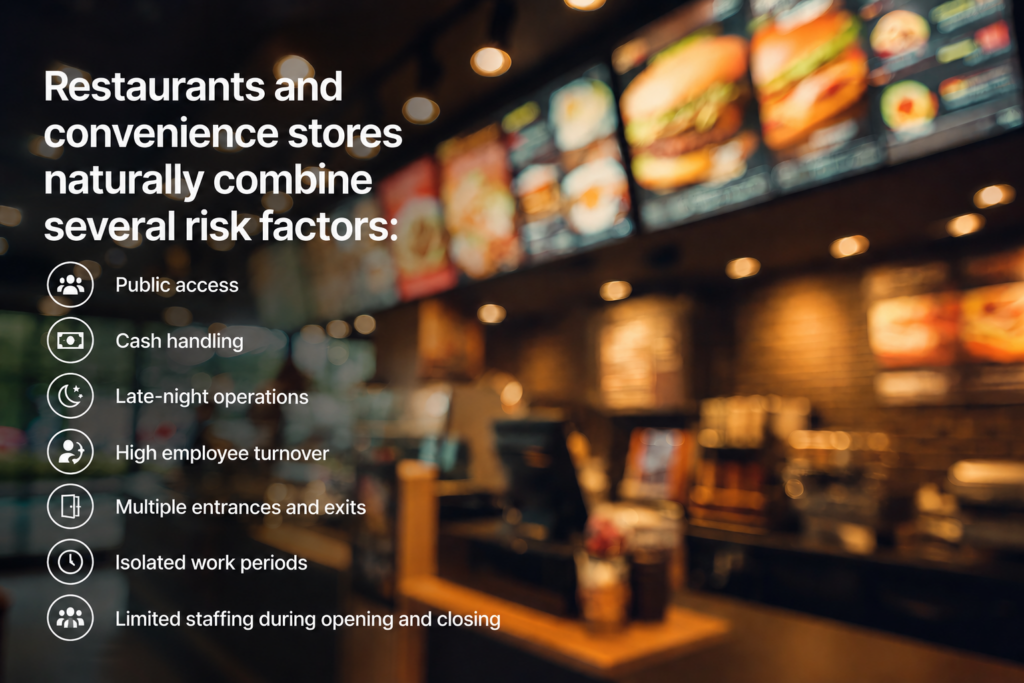
According to the U.S. Bureau of Labor Statistics, workplace violence remains a significant concern in retail and food-service environments where employees regularly interact with the public and handle cash.
For operations leaders, employee safety has evolved beyond a security discussion. It has become a liability, compliance, and business continuity concern.
When Employees Are Most Vulnerable
Many incidents occur during transition periods when staffing levels are at their lowest.
High-risk situations often include:
- Opening procedures
- Closing procedures
- Cash-counting activities
- Trash removal
- Delivery acceptance
- Accessing storage or cooler areas
- Walking to and from parking lots
The challenge is not simply recording incidents after they occur. The challenge is identifying potential threats while there is still time to intervene.
What 24×7 Restaurant Monitoring Actually Looks Like
Most restaurants already have cameras.
The difference is whether those cameras are simply recording events or actively helping protect employees.
Traditional CCTV systems are largely reactive. They provide evidence after an incident occurs.
Modern proactive monitoring solutions are designed to identify potential threats while events are unfolding.
How Proactive Monitoring Works in Practice
Many organizations already have a camera system in place. The difference is whether those cameras are simply recording events or actively helping protect employees in real time.
A modern proactive visual security platform combines intelligent analytics, live operator oversight, and real-time intervention tools into a single workflow.
A typical sequence looks like this:
- A camera detects activity.
- AI analytics evaluate whether the activity appears suspicious.
- The event is delivered to a monitoring operator through the Video Control Panel.
- The operator reviews live video and determines whether intervention is necessary.
- If appropriate, the operator initiates a response using IP Speakers, contacts site personnel, or escalates the event for dispatch.
This process transforms video from a passive recording tool into an active security resource.
For organizations evaluating a proactive visual security platform, the ability to move from detection to verification within seconds can be the difference between documenting an incident and preventing one.
Proactive Monitoring vs. Traditional CCTV
| Traditional CCTV | Proactive Monitoring |
|---|---|
| Records incidents | Deters incidents |
| Reviewed after events occur | Evaluated as events develop |
| Limited alarm context | Live visual verification |
| No intervention capability | Real-time intervention |
| Reactive response | Proactive response |
| Limited lone worker support | Designed to support lone workers |
The objective is no longer simply documenting incidents.
The objective is to prevent escalation.
Security Technologies That Improve Employee Safety
One of the biggest frustrations with traditional surveillance systems is alert fatigue.
Basic motion detection often generates notifications from:
- Passing vehicles
- Animals
- Weather conditions
- Routine customer activity
Modern AI-powered analytics with reliable camera detectors can identify behaviors more closely associated with actual security concerns, including:
- Loitering
- Perimeter breaches
- Unauthorized after-hours activity
- Restricted-area access
- Suspicious lingering near employee entrances
This helps operators focus attention where risk is greatest.
Two-Way Audio Creates Immediate Intervention Opportunities
One of the most effective but underutilized security tools is two-way communication.
When trained operators can immediately address suspicious individuals, situations often de-escalate before they become incidents.
Examples include:
- Warning trespassers
- Addressing loitering
- Directing individuals away from restricted areas
- Advising that authorities have been notified
For employees working alone, hearing a live operator intervene provides reassurance that someone is actively monitoring the situation.
Video Verification Improves Response
Traditional alarm systems often leave responders with limited information.
Video verification provides critical context such as:
- Number of individuals involved
- Nature of the activity
- Direction of travel
- Potential weapons
- Real-time updates
This additional information can improve response quality and reduce uncertainty during emergencies.
Video Documentation Supports More Than Security
Not every incident involves criminal activity.
Recorded video frequently supports:
- Human resources investigations
- Customer disputes
- Insurance claims
- Safety reviews
- Operational audits
Consistent documentation can be just as valuable as the initial response.
Verified Dispatch and Real-Time Intervention
One area where many restaurant security solutions fall short is response.
Traditional alarm systems often generate alerts with little context. Operators, managers, and law enforcement may not know whether an event represents a genuine threat or a false alarm.
Video verification changes that.
When monitoring personnel can visually confirm an incident through live video, they can provide critical information about what is actually occurring. This may include the number of individuals involved, whether weapons are visible, the direction of travel, and whether employees remain at risk.
Such verified information helps support faster, more informed response decisions.
For lone workers facing a robbery, workplace violence incident, or aggressive customer interaction, every minute matters.
Organizations can also use IP Speakers for verbal intervention. A live operator can address suspicious individuals, warn trespassers, or notify them that authorities have been contacted. In many situations, intervention alone is enough to stop unwanted activity before it escalates.
Best Practices for Restaurant Camera Placement
The effectiveness of a surveillance system depends heavily on camera placement.
Many organizations focus primarily on entrances and registers while overlooking areas where employees are most likely to be alone.
Employee Entrances
Employee entrances should receive dedicated coverage with strong nighttime visibility and clear identification capabilities.
Parking Lots
Parking lots are among the highest-risk locations for lone workers.
Coverage should include:
- Employee walking paths
- Vehicle parking areas
- Building approaches
Drive-Thru Lanes
Drive-thru cameras can provide visibility into customer interactions while also supporting after-hours monitoring.
Back-of-House Areas
Coverage should extend to:
- Walk-in coolers
- Storage rooms
- Delivery areas
- Service corridors
A useful planning question is simple: Where is an employee most likely to be alone?
Those areas should receive the highest priority.
Compliance, Liability, and Duty of Care
Employers have a responsibility to provide safe workplaces and address foreseeable risks.
Safety leaders increasingly ask:
- How are lone workers protected?
- What procedures exist during emergencies?
- Can incidents be verified and documented?
- Are safety standards consistent across all locations?
These questions move security beyond cameras and into broader risk-management strategies.
Documented procedures, video records, and verified response protocols can help organizations demonstrate due diligence following an incident.
OSHA, Documentation, and Defensible Response Procedures
While OSHA does not maintain a specific lone-worker standard for restaurants, employers remain subject to the OSHA General Duty Clause, which requires organizations to provide employees with a workplace free from recognized hazards likely to cause serious harm.
For operations leaders managing dozens or hundreds of locations, documenting how incidents are identified, escalated, and resolved can become just as important as the technology itself.
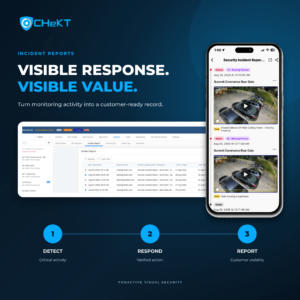
This is where centralized incident documentation plays an important role.
Solutions such as CHeKT Video Vault provide timestamped video evidence and event records that can support:
- HR investigations
- Insurance claims
- Workplace violence reviews
- Incident reconstruction
- Compliance documentation
- Internal safety audits
Organizations that can demonstrate consistent safety procedures, documented response actions, and centralized oversight are often better positioned to defend their decisions following an incident.
Scaling Lone Worker Protection Across Multiple Locations
Protecting one restaurant is challenging.
Protecting 50, 100, or 500 locations requires a scalable approach.
Successful enterprise deployments typically include:
- Standardized procedures
- Centralized oversight
- Consistent response workflows
- Scalable technology
- Minimal operational disruption
Organizations should evaluate technologies that integrate with existing infrastructure whenever possible, reducing deployment costs and accelerating implementation.
What One Serious Incident Can Cost
Security discussions often focus on monitoring expenses.
A better question may be:
What does one serious incident cost?
Potential consequences include:
- Workplace violence
- Employee injury
- Temporary closure
- Litigation
- Insurance claims
- Employee turnover
- Brand damage
Viewed through this lens, employee safety investments become less about security spending and more about operational resilience.
Building a Safer Environment for Employees
The best restaurant security strategies are no longer focused solely on protecting property.
They are designed to protect people.
Modern proactive monitoring combines intelligent detection, real-time oversight, verified response, and documented incident management to help organizations create safer environments for employees across every location.
For operations leaders responsible for multiple sites, the ability to identify threats early, support lone workers, and standardize safety procedures can significantly improve both employee protection and business continuity.